Circular economy language has become mandatory in outdoor brand reporting, and its practical expression is often limited to a take-back programme and a sustainability page. Klättermusen is the counterexample: a Swedish mountaineering manufacturer that built its design philosophy around material hierarchy in the late 1990s, when the term circular economy was not yet part of corporate vocabulary, and whose current products can be serviced at component level rather than replaced wholesale. That consistency over three decades is what distinguishes a genuine circular strategy from a circular communications strategy.
The Waste Hierarchy as a Design Brief
The framework the brand adopted has a specific order of priority: prevent waste by designing for longevity, then reuse components, then repair, then recycle materials, and only then recover energy. Applied to product development it produces distinctive outcomes. Materials must be chosen not just for performance but for durability and for separability at end of life. Components must be replaceable, which means mechanical fastening where a bonded construction would be more elegant. Coatings must be avoided where they would prevent material recycling. This produces heavier and sometimes less refined products than the market expects, and a service life that is unusually long. It is a trade-off the brand has made deliberately for thirty years.
Component-Level Serviceability in Practice
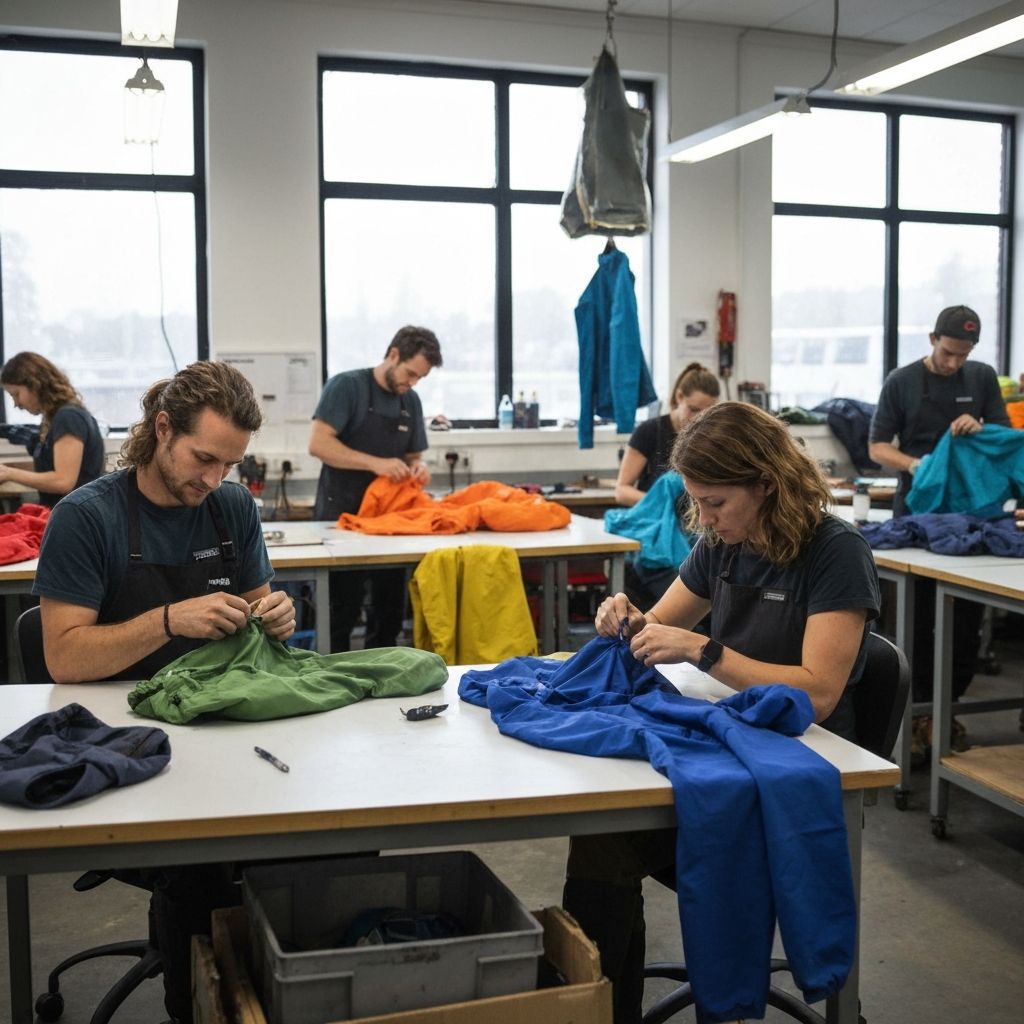
Klättermusen's technical garments specify zippers, hood structures, cord systems and reinforcements as replaceable parts. This shows in design details that are easy to miss: zippers that extend beyond the storm flap so a tailor can access the tape, hood adjustment components that can be unscrewed rather than bonded, and reinforcement panels that are stitched rather than welded so they can be replaced when abraded. The practical consequence is that a jacket whose hood adjustment cord fails, or whose main zipper dies, can be restored for a fraction of replacement cost. Most failure events in technical clothing are component failures rather than fabric failures, and designing around that reality is the single highest-leverage decision available.
Materials: Durability Over Novelty
The fabric strategy prioritises long-life high-tenacity polyamide and recycled variants over lighter, more novel materials. Where water repellency is needed, fluorocarbon-free treatments have been standard well ahead of regulation, at some cost in sustained repellency. The brand's heavier face fabrics resist abrasion far better than the ultralight constructions that dominate modern alpine apparel, which is why our field testing consistently shows these garments reaching year five in better condition than lighter competitors. The cost is weight: a Klättermusen shell is typically 30 to 50 percent heavier than a comparable ultralight alternative. For a mountaineering brand whose customers climb granite and ice, that is a defensible trade. For a trail runner, it is not.
The Limits of a Small-Scale Circular Model
Scale is the honest weakness. Component-level serviceability requires stocking spare parts across multiple product generations, training repair partners and maintaining documentation, all of which impose costs that volume amortises and small production runs do not. The result is high retail pricing and limited availability: a repair network that would be trivial for a company selling hundreds of thousands of units is a significant undertaking for one selling tens of thousands. This is the structural reason circular models are more common among smaller brands with premium positioning, and why large brands tend to adopt recycling and take-back instead of repair. Repair economics depend on scale, and scale is precisely what voluntary circularity struggles to reach.
What the Model Proves
Three lessons transfer to the wider industry. Longevity must be designed in at the construction-detail level, not asserted in a mission statement: zipper access, replaceable components and separable materials are the substance. Second, circular design costs weight and money, and brands should be honest about that trade rather than claiming a free lunch. Third, a repair programme needs parts, documentation and pricing transparency to function, because a repair promise without a part number is a support ticket rather than a service. Klättermusen has done all three for decades without a marketing campaign built on it, which is the least fashionable and most persuasive evidence that the model works.
References
Data sources, standards and publications consulted for this article. Where a figure could not be traced to one of these, we say so in the text rather than presenting it as verified.
- [1]Product specifications and environmental documentationKlättermusen · 2026
- [2]Circular economy principles for textiles and durable goodsEllen MacArthur Foundation · 2025
- [3]Waste hierarchy definitions and application guidanceEuropean Commission, DG Environment · 2025
- [4]Recycled content verification approaches in textile supply chainsTextile Exchange · 2025
Sarah reports on circular business models and has visited repair facilities across Europe, Japan and the United States.
Equipment referenced in this article
Each item has its own specification sheet with full measurements, pricing and verdict.
Tap an item to expand specifications, or open its full record in the database.