Insulation is where circularity gets hard. A cotton shirt can be shredded and re-spun; a polyester fleece can be melted and re-extruded. A down jacket is a laminate of natural and synthetic components, adhesive, thread, zipper tape and hardware, and separating those materials economically is a materials-science problem rather than a logistics one. Rab, a British brand with a fifty-year history in down and synthetic insulation, has built a circular programme around exactly that difficulty, and its scope and limits make it the most instructive case study available in the category.
Why Insulation Resists Recycling
Two structural problems. First, blended construction: a single garment typically contains shell fabric, lining fabric, insulation, adhesive, seam tape, zipper tape, thread and hardware, and each material must be separated before recycling can produce usable output. Mechanical separation works reasonably where construction is stitched rather than bonded, and poorly where insulation is laminated or resin-treated. Second, quality degradation: mechanically reclaimed down loses fill power as fibres break, so recovered down typically returns to lower-specification applications rather than to the premium jackets it came from. The same applies to recycled synthetic insulation, where short fibres reduce loft. The honest conclusion is that insulation recycling can extend material life but rarely achieves closed-loop recovery at original specification.
Down: The Better-Behaved Material
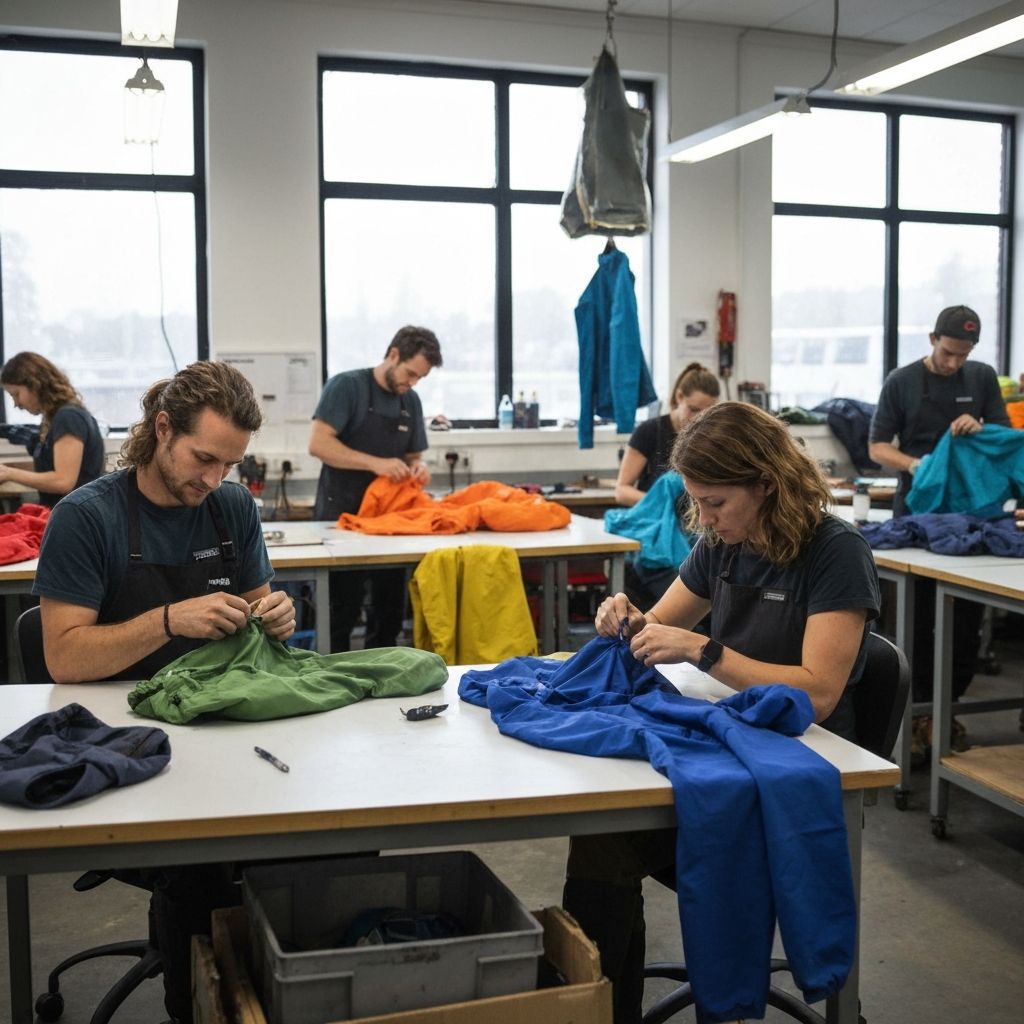
Down is the more tractable of the two insulations, for a specific reason: it can be recovered, cleaned and re-used with relatively modest quality loss provided contamination is controlled. Removal of down from a stitched baffle construction is straightforward, and washing and re-filling is a mature industrial process. Rab's own repair and re-fill operations confirm this in practice, and it explains why the brand's circular efforts concentrate on down products: the material is recoverable, the market for recovered down exists, and the certification chain through the Responsible Down Standard provides traceability that makes the output credible. Synthetic insulation has no equivalent property, because resin-bonded sheets cannot be un-bonded and re-bonded into high-loft insulation.
Repair Throughput and What It Reveals
Repair operations provide the most useful data any brand has about how its products actually fail, and Rab's repair categories align with our independent findings across the entire industry: zippers and baffle damage dominate, followed by fabric abrasion. The implication for design is consistent: baffle construction should allow re-filling without destroying the shell, zippers should be accessible for replacement, and reinforcement should be placed where abrasion occurs rather than distributed decoratively based on aesthetics. Where brands differ is in the detail of execution: through-access to baffles, seam reinforcement at stress points and standardised zipper specifications all determine whether a repair takes twenty minutes or two hours, and therefore whether it is economically sensible at all.
The Take-Back Problem Nobody Talks About
Take-back schemes are popular in sustainability reporting because they are easy to announce and straightforward to operate: give a customer a discount for returning a garment, and either resell or recycle it. The problem is the material flow. Returned garments arrive in unpredictable condition, with contamination from use, and must be sorted into resaleable, repairable and recyclable fractions. Resaleable is the most valuable and least predictable. Recyclable is the least valuable and the most technically demanding. A substantial proportion of returned insulation garments is neither, which is the operational reality behind circular claims. The brands doing this well operate closed loops for specific product lines with controlled construction, rather than accepting all comers and hoping for the best.
A Realistic Assessment
Rab's programme is genuine and among the more substantive in the category, and it demonstrates the ceiling clearly. Down recovery works. Repair works, and matters most in practice. Recycling of synthetic insulation remains an unsolved materials problem, and no amount of take-back logistics will change that. Regenerated synthetic insulation will have lower loft than virgin material for the foreseeable future, so the category's honest sustainability strategy is not recycling but longevity: repair the zipper, re-fill the baffles, re-proof the shell, and keep the garment in service for fifteen years. That is a less satisfying narrative than a closed loop, and it is what the material science actually supports. Buyers should treat any claim of fully circular insulation with appropriate scepticism and ask which specific product line and which material, because the general claim does not survive specific questions.
References
Data sources, standards and publications consulted for this article. Where a figure could not be traced to one of these, we say so in the text rather than presenting it as verified.
- [1]Responsible Down Standard and chain of custody requirementsTextile Exchange · 2025
- [2]Textile recycling technology and fibre recovery limitationsEllen MacArthur Foundation · 2025
- [3]Waste framework directive and textile waste obligationsEuropean Commission, DG Environment · 2026
- [4]Down and feather recovery, cleaning and re-use practiceInternational Down and Feather Bureau · 2024
Elena has spent eleven seasons testing waterproof-breathable laminates for alpine and ski-touring use, and holds a materials engineering background from ETH Zürich.
Equipment referenced in this article
Each item has its own specification sheet with full measurements, pricing and verdict.
Tap an item to expand specifications, or open its full record in the database.