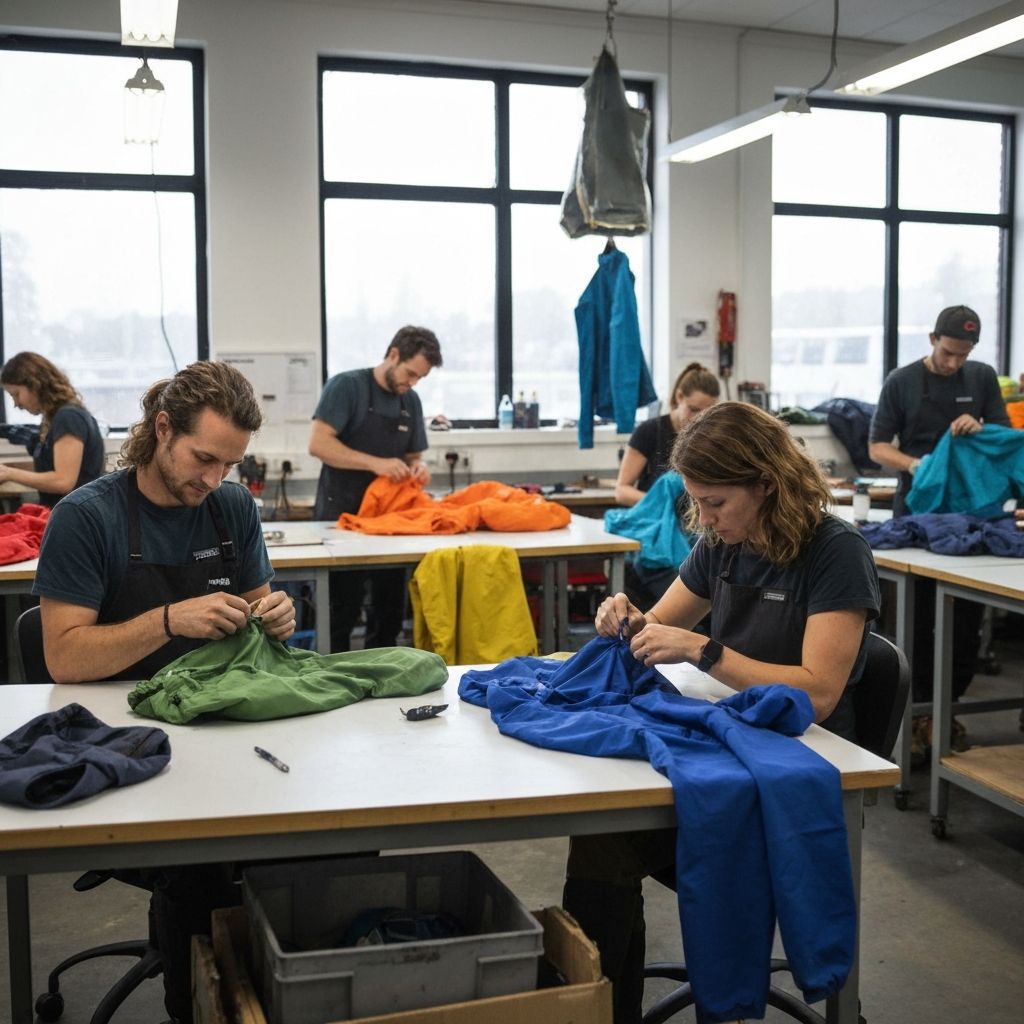
In the lobby of Patagonia's Reno repair facility, a sign reads: 'The most sustainable product is the one already made.' It's a statement that would seem to contradict basic business logic—why would a company actively discourage sales?—yet Patagonia's consistent revenue growth and industry-leading brand loyalty suggest they've discovered something competitors are scrambling to understand: customers will pay more and stay longer with brands that align with their values, even when those values include buying less.
The Worn Wear Facility: Industrial-Scale Repair
The Reno facility occupies a converted warehouse where 85 full-time technicians repair approximately 120,000 garments annually. Walking the floor feels more like touring a surgical center than a factory—individual workstations equipped with specialized machines for zipper replacement, patch applications, and seam reconstruction. The complexity becomes apparent quickly: a simple jacket repair might require matching thread color to a dye lot from 2013, sourcing a discontinued zipper from archived parts, and reconstructing a seam in a way that maintains waterproofing. 'We're not just sewing patches,' explains head technician Maria Gonzales. 'We're preserving the original engineering of each garment, which means understanding how it was made in the first place.'
The Economics of Anti-Growth
The Worn Wear program costs Patagonia approximately $12 million annually to operate, according to company figures. Basic repairs cost customers $15-45, representing significant subsidies from Patagonia. On paper, this seems financially irrational—why spend millions enabling customers to avoid new purchases? The answer lies in customer lifetime value. Internal data shows that customers who use the repair service have a 67% higher lifetime purchase value than those who don't, and 89% higher brand loyalty scores. They're also more likely to recommend the brand, generating word-of-mouth marketing that Patagonia values but doesn't include in traditional ROI calculations. The repair program isn't separate from the business model—it is the business model.
Design for Repair: Engineering Longevity from Inception
Patagonia's commitment to repairability influences design from the earliest stages. Every new product must pass a 'repair audit' before production approval, ensuring that common failure points can be accessed and replaced without specialized equipment. This affects material choices (avoiding bonded seams that can't be separated), construction techniques (using bar tacks that can be removed and redone), and even aesthetic decisions (accepting slight visual compromises if they improve structural durability). Design director Nicole Bassett walks us through a prototype jacket: 'See how the zipper extends beyond the storm flap? That's intentional—it makes replacement easier. The pocket placement? Positioned so patch repairs won't interfere with load-bearing seams.' These micro-decisions, invisible to consumers, accumulate into garments that can be meaningfully repaired rather than merely patched.
The Skills Gap: Repair as Lost Knowledge
One unexpected challenge: finding qualified repair technicians. 'Industrial sewing skills are vanishing,' Gonzales notes. 'Garment production moved overseas decades ago, and we're now competing for a shrinking talent pool.' Patagonia has responded by creating their own training program, bringing in people with basic sewing knowledge and developing specialized repair skills over 6-12 months. The program has become an unusual entry point into the outdoor industry for people without traditional outdoor backgrounds, creating diverse teams where a technician might be equally passionate about fabric construction and restorative justice. This human infrastructure—the accumulated knowledge and skills of the repair team—represents an asset that can't be easily replicated by competitors.
Replication Challenges: Why Others Aren't Following
Despite Patagonia's success, few competitors have launched comparable programs. The barriers are substantial: repair requires maintaining archives of every component ever used, complex reverse logistics, skilled labor, and most importantly, a willingness to prioritize long-term brand building over short-term revenue. For companies answering to investors demanding quarterly growth, these trade-offs are difficult to justify. Patagonia's private ownership and patient capital enable strategies that would face resistance in public markets. Yet there are signs of change. REI recently expanded their repair services, and several European brands have launched pilot programs. The question isn't whether repair becomes industry standard—it's how long the transition takes, and whether it comes voluntarily or through regulation, as proposed Extended Producer Responsibility laws suggest it might.
Equipment referenced in this article
Each item has its own specification sheet with full measurements, pricing and verdict.
Tap an item to expand specifications, or open its full record in the database.